 Croatia Waterfalls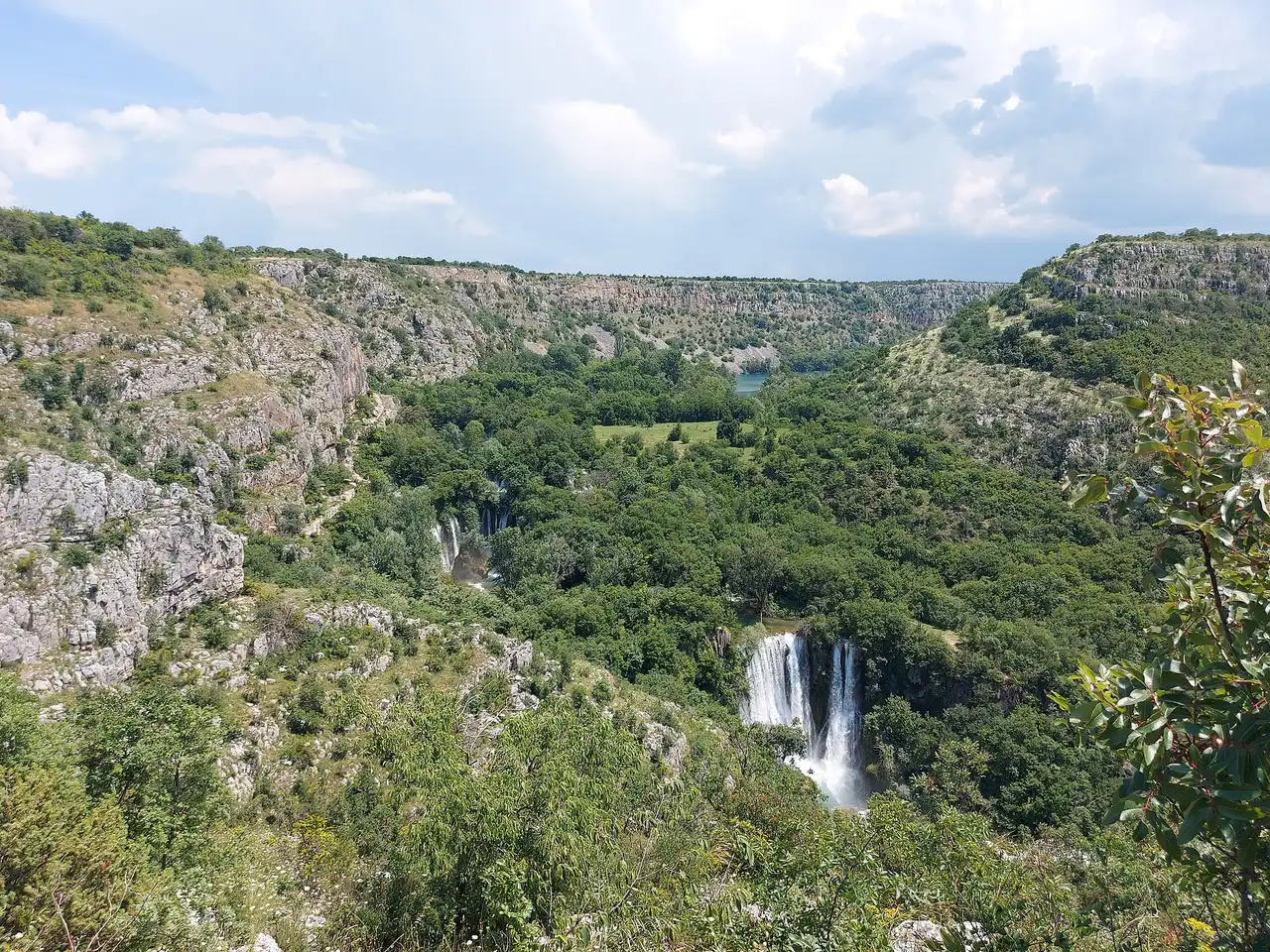
The manojlovac slap is the fall that the brochures skip and the river keeps for itself: a broad, multi-step travertine curtain roughly 60 metres in combined drop — the tallest and most powerful barrier on the Krka proper — seen not from a boardwalk but from a free roadside terrace above the canyon, an emperor's viewpoint that has been drawing visitors since 1875. No ticket is sold here, no boat lands here and no tour stops here; the site belongs to the backroad circuit above the Miljevci plateau, past the Roman camp of Burnum. This page covers the barrier's real dimensions, the flow problem created by the upstream hydro plant, the exact driving logic and the honest pairing options. The paid park sits downstream — its mechanics on the Krka tickets page, its main barrier on the Krka falls guide, the country-wide directory on the Croatia Waterfalls homepage.
Quick answer The drop, the free access, the flow caveat and the drive in one read
Checked on 13 September 2026: the barrier drops roughly 60 metres over a series of travertine steps — the park lists 59.6 m total with the last and tallest single barrier at 32.2 m — and the viewpoint terrace above it is free and always open. Two caveats decide the visit: the Miljacka hydro plant diverts most of the water in the warmer months, so the curtain is thin from late spring to autumn; and no tour stops here — you need a car or a taxi. The site is one of the anchors of the free waterfalls circuit. Access detail below; the paid park sits on the Krka falls guide.
Key takeaways
- Free and always open: no ticket, no gate, no desk — an open terrace above the canyon.
- Roughly 60 m of combined drop over steps; the final single barrier is about 32 m.
- Flow caveat: the hydro plant upstream takes most of the water in the warm season — spring is the loud visit.
- No tours stop here; reach it by car via the Burnum / Miljevci road network.
- The terrace has a 19th-century pedigree: Emperor Franz Joseph I visited in 1875, and the inscription survives.
Key facts
Opening hours
| Roadside viewpoint, always visible | 00:00–24:00 |
|---|
Closed None — the terrace is an open roadside site with no gates or ticket desk
Admission
- Adult
- Free — the viewpoint sits outside the park's paid localities; no ticket desk operates here
- Reduced
- Free
- Free
- Everyone; the paid localities with their bands sit downstream
Planning it
- Time needed
- 30-45 min
- Address
- Krka canyon above the falls, near Miljevci / Burnum road fork, Šibenik-Knin County, Croatia
Manojlovac Slap: No Ticket, and the Nearest Bookable Products
The viewpoint is free — the only money decision on this page is whether to bolt a paid park visit onto the drive. The official rows below point to the park's own sources; the tour rows are the nearest bookable products, not products that stop here.
The honest framing: your ticket money buys the park downstream, and your car buys this terrace:
| Option | Season / window | Adult price | What it covers | Where it books | Book |
|---|---|---|---|---|---|
| The viewpoint itself — official locality pageAnyone planning the free circuit | Open all year, always visible | Free | The terrace above the canyon; the road fork near Burnum serves it | Official locality page | Official site |
| Krka park price list (2026 PDF)Anyone bolting the paid localities onto the day | Season bands per locality group | Roughly €10-40 peak — confirm on the list | The paid land localities downstream, boat and shuttle in season | Official cjenik | Official site |
| Afternoon tour from Zadar, tickets includedZadar-based visitors without a car | Afternoon departures in season | From ~$75 on the card | The nearest Krka product to the canyon — but it visits the main barrier, not this terrace | Tour card | Check Availability |
| Guided park tour from SplitSplit-based visitors building a region loop | Daily in season | From ~$75 on the card | The nearest bookable regional product — again the paid park, not the free terrace | Tour card | Check Availability |
| Descending into the canyon below the terraceAnyone expecting a walk to the river | All year | Not provided | The falls are viewed from above; the river below is park zone — no bathing | Skip it — view from the terrace | Check Availability |
The Tallest Drop on the Krka Proper
Numbers first: the park lists 59.6 metres of total drop across a series of barriers, 500 metres long and 80-100 metres wide.
Manojlovački slap sits 19.5 kilometres from the Krka's source and is, by the park's own description, the highest and most powerful waterfall on the river itself. The drop is not one wall but a sequence: the river runs 500 metres through a chain of travertine barriers 80-100 metres wide, shedding roughly 60 metres of elevation in total, with the final barrier — also the tallest single one — plunging 32.2 metres where the canyon turns sharply from northwest to southeast. Seen from above, the effect is a broad white ladder laid diagonally across a green canyon, quite different in character from the stepped staircases downstream.
The site has pedigree. The viewpoint terrace above the fall carries an inscription carved into the living rock commemorating a visit by Emperor Franz Joseph I and his entourage in 1875 — imperial Dalmatia came to see this fall, and the terrace has changed less than almost anything else on the river. The canyon walls around it hold maidenhair fern, a Tertiary relict, and the long travertine curtains that give the fall its texture are built by the same living moss deposits as every other barrier on the river.
Dimensions, the 32.2 m final barrier and the 1875 inscription from the park's Manojlovački slap locality page, checked 13 September 2026.
The Flow Caveat and Finding the Viewpoint Terrace
Two practical facts decide the visit: how much water is running, and which road fork to take.
The flow caveat first: during the warmer part of the year, most of the river's water is diverted by the Miljacka hydroelectric plant upstream, and only a fraction passes over the barriers — the park says so plainly on the fall's own page. In spring, and in the wet weeks of autumn, the curtain runs full and loud; by August it can be a set of thin white threads. The single best planning rule for this site is therefore seasonal, not hourly: come in spring for the show, accept the threads in summer, and treat the terrace as a viewpoint first and a waterfall second in the dry months.
The access is a backroads affair. The terrace sits above the canyon on the road network that also serves the Burnum archaeological site — the Roman military camp and amphitheatre on the right bank — on the Miljevci plateau side. Drivers leave the main Drniš–Knin roads, follow the signed local roads toward Burnum and the canyon rim, and park informally near the terrace; the final stretch is narrow local tarmac and the site has no facilities, no railings budget and no ticket desk. The honest drive-time arithmetic: roughly 30-40 minutes from Skradin or the park's main gates, about 45 minutes from Knin, and a longish but scenic run from Zadar via Kistanje. No public transport reaches the terrace; the nearest bookable products with wheels are the Zadar afternoon tour and the Split park tours — both of which visit the paid park, not this site.
- Spring visit = full curtain; late summer = thin threads (the hydro plant takes the water).
- Access via the Burnum / Miljevci backroads; the final stretch is narrow local tarmac.
- No facilities at the terrace — water, shoes and fuel sorted before the turn-off.
- Pair it with Roški slap and the canyon road circuit; one tank of fuel covers the day.
- Confirm current access notes on the park's locality page before a winter visit — the backroads ice first.
- Keep to the marked viewpoint: the canyon rim is unfenced beyond it.
- No bathing in the river below — the park rulebook applies even at the free sites.
The hydro-diversion flow note and the access framing from the park's locality page and published park rules, checked 13 September 2026.
The Free Krka Falls Side by Side
Four barriers on the upper and middle river sit outside the paid localities; the table compares them from the park's locality pages checked on 13 September 2026.
| Barrier | Drop | Access | Flow character | Pairs with |
|---|---|---|---|---|
| Manojlovac slap | Roughly 60 m over steps (59.6 m per the park) | Roadside terrace above the canyon, near Burnum | Tallest and most powerful; thins in the warm months | Roški slap and the backroad circuit |
| Bilušića buk | 22.4 m over 300 m | Roadside below Knin, short walk | First barrier; flows year-round | The Krčić and the Knin headwaters |
| Miljacka slap | 23.8 m, three large steps | Quiet backroads by the power plant | Strong single drop in a roadless canyon | Manojlovac and the Kistanje roads |
| Krčić waterfall | About 25 m | Roadside near Knin, free | Seasonal — strong after rains, dry by late summer | Knin fortress and the source country |
Manojlovac Slap Map: the Terrace, Burnum and the Circuit
The viewpoint above the canyon, the Roman camp on the same road network, and the barriers that make the backroad day.
The Nearest Bookable Tours
No tours stop at the terrace — there is no ticket to sell and no coach turning space. The nearest bookable Krka products are below; use them for the paid park and drive (or taxi) the backroads for the fall itself.
 from $75.18
From Zadar: Krka Waterfalls Afternoon Tour - Tickets Included
Afternoon Krka trip from Zadar with tickets included — built for the quiet late hours.
Check Availability from $75.41
From Split: Plitvice Lakes National Park Guided Tour
Guided Plitvice day tour from Split covering the UNESCO lake terraces with hotel-zone pickup.
Check AvailabilityPrices, ratings and details are the platform's own, checked in Q3 2026; dollar figures are the listed prices — the platform bills in your account's currency.
Is the viewpoint really free?
Yes. The terrace sits outside the park's paid localities — no ticket desk, no gate and no fee. The paid bands apply at the land localities downstream; the free backroad barriers are covered on the free waterfalls page.
How high is the fall, exactly?
The park lists 59.6 metres of total drop across the barrier sequence, 500 metres long and 80-100 metres wide, with the final single barrier at 32.2 metres. In round numbers: roughly 60 metres over steps — the tallest barrier on the river proper.
Why is the fall sometimes barely running?
The Miljacka hydroelectric plant upstream diverts most of the river's water during the warmer months, and the park's own locality page says the fall carries only a small flow then. Spring and wet autumn weeks are the loud visits; in August expect thin threads.
Can you reach it without a car?
Not practically. No public transport reaches the terrace and no tour stops there. The nearest bookable products — the Zadar afternoon Krka tour and the Split park tours — visit the paid park downstream; for the terrace you need your own wheels or a taxi from Drniš or Skradin.
Can you swim in the river below the fall?
No. The park's bathing ban covers the whole park zone, free sites included, and the canyon below the terrace is park territory. The lawful swim rivers are listed on the legal swimming page.
What else is on the same road circuit?
The Burnum archaeological site — the Roman military camp and amphitheatre — sits on the same local road network, and the Roški slap barrier with its mills is half an hour further down the plateau. The full backroad day is laid out on the road-trip circuit.
How does this fall compare with the famous one downstream?
Different in kind: this is the river's tallest and most powerful drop, seen from above a wild canyon with no infrastructure, while Skradinski buk is a walked staircase with mills, museums and boats. The honest comparison sits on the Krka falls guide.
Where to Go From the Terrace
The pages this one leans on — the barriers up- and downstream and the free-falls circuit:
Roški slap
The necklace barrier and its mills — the ticketed pairing stop half an hour down the circuit.
Miljacka slap
The strong single drop by the power plant, on the backroads toward Kistanje.
Free waterfalls in Croatia
The country-wide list of falls that cost nothing — this terrace is one of the best.
Waterfalls near Zadar
The Zadar day-trip radius, including the afternoon tours that cover the paid park.
Krka falls guide
The whole park: gates, bands, boats and the main barrier.
Reviewed Q3 2026 (July–September 2026); next review Q4 2026. Prices, hours and terms are set by the venue or operator and confirmed at checkout.
We may earn a commission if you book through one of our links, at no extra cost to you. Full affiliate disclosure